Most doors sold as “security doors” in Texas are a steel grille bolted over the door you already have. They work, in the sense that they are harder to get through than nothing. They also announce to the street that you were worried, and they do nothing about the two places an entry actually fails.
A custom steel entry door is a different proposition: the security is structural, so it is invisible. Here is what actually makes an entry hard to force, and which of it comes standard.
Where entry doors actually fail
Almost no forced entry involves cutting a door. Three things fail instead, in this order:
The jamb, not the door
The most common forced entry in a residential break-in is a kick that splits the frame around the strike plate. The door itself is intact; the wood around the latch is not. A steel jamb removes that failure mode, which is why the jamb specification matters more than the slab specification.
The glass beside the door
A sidelight next to the handle is a hole in the security of the whole assembly. Reaching through broken glass to turn a thumb-turn from the inside takes seconds. This is an argument for a single-cylinder deadbolt placed thoughtfully, and for tempered glass, which does not leave a reachable opening the way annealed glass does.
The inactive leaf of a double door
On a pair of doors, the leaf that does not open every day is the weak one, unless it is properly secured top and bottom. Two flush bolts is the standard we build to. One is not enough, and none is common in cheap double units.
What comes standard on every door we build
- Profiles formed in house from 11-gauge steel — no filler, no hollow tube stock behind a skin
- A 6" or 8" steel jamb, so the frame is not the weak point
- Double tempered insulated glass, which breaks into blunt pieces rather than a reachable opening
- A single-cylinder deadbolt with two keys, plus a roller latch
- Two flush bolts on the inactive leaf of every double door
- Full perimeter weather stripping and a threshold sweep — a door that seals tight is a door that sits tight
None of that is an upgrade or an add-on package. It is the base specification, because a door built any other way is not worth building.
Gauge is the number that matters
Steel thickness is measured in gauge, and lower is thicker. We form our profiles from 11-gauge. Plenty of doors sold as steel are much thinner sheet wrapped around a hollow tube or a foam core, which is fine for weather and useless for force. If you are comparing quotes, this is the single question that separates them: what gauge, and is it solid or a skin?
The part nobody mentions: deterrence
A visible steel-and-glass entry that obviously belongs to the house reads as a considered, well-built home. A grille screwed over a builder-grade door reads as a house that has already had a problem. Both are security decisions. Only one of them also improves what you come home to.
Security without turning the house into a fortress
The reason people hesitate on security doors is aesthetic, and it is a fair hesitation. The way through it is glass and grid pattern. A generous glass area with a tight steel grid gives you light and a view from inside, a clear sightline to whoever is at the door, and a physical barrier that does not read as one from the street.
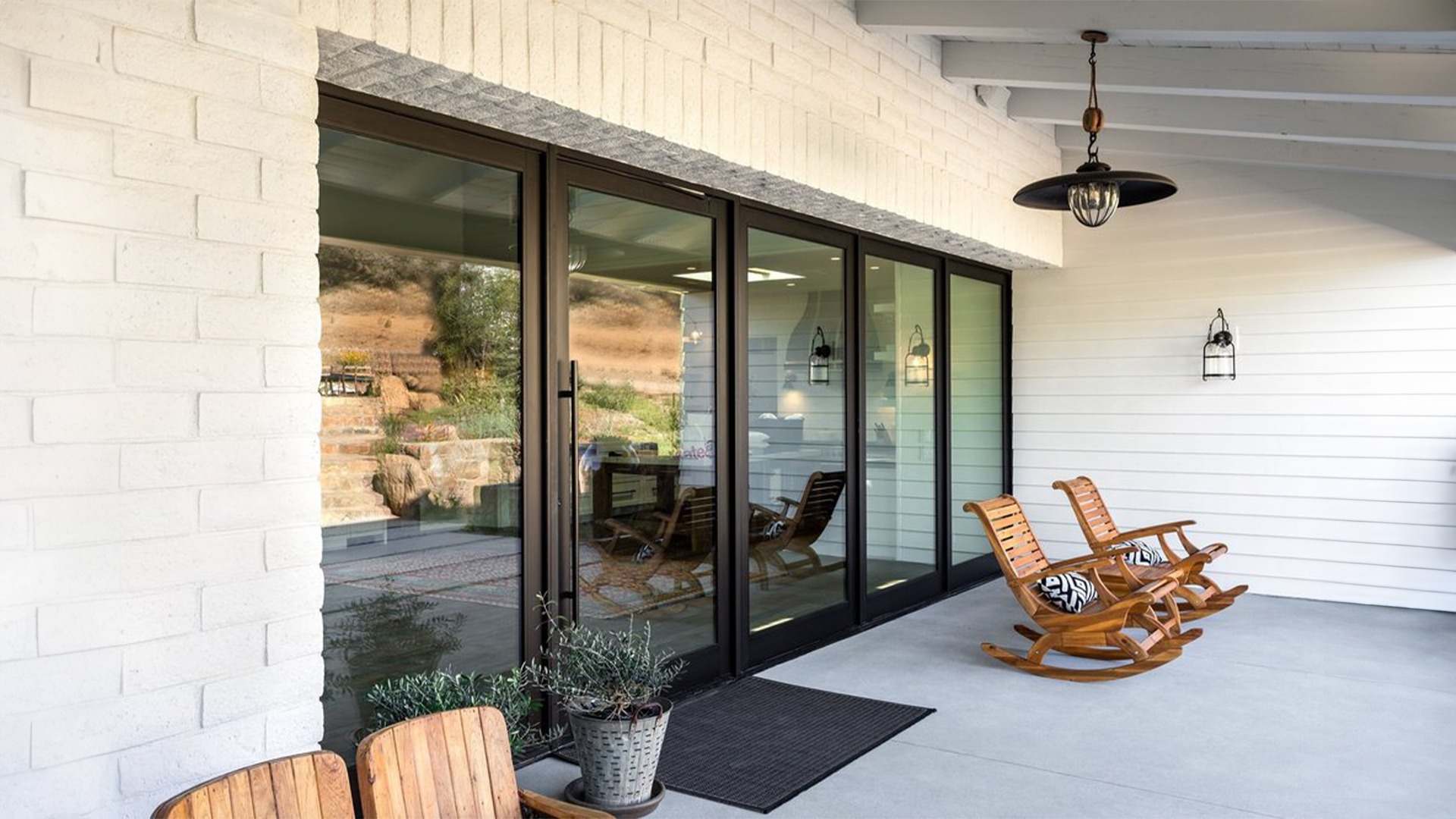
For patio and rear entries — statistically the more common point of entry — the same logic applies to steel patio doors and sliding doors, which are usually the least secure openings in an otherwise secure house.
See it in person
Browse wrought iron entry doors and steel entry doors, or visit a showroom in San Antonio, Houston or Austin and put your hands on the jamb and the flush bolts. That is the fastest way to understand the difference. Request a free design consultation and we will measure your opening.